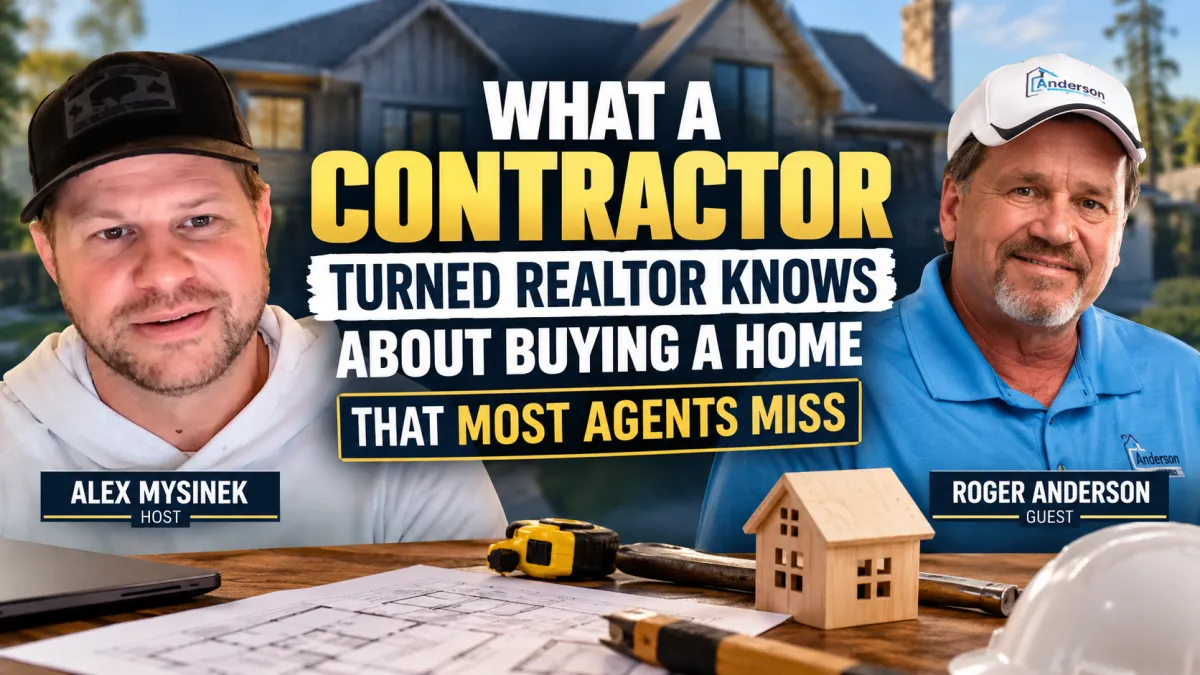
Beyond the Listing: Alex Mysinek Talks Construction Secrets and Home Buying Pitfalls With Roger Anderson
The Realtor Who Has Been in the Construction Trade Since He Was Eight Years Old
Alex Mysinek sat down with Roger Anderson, owner and broker of Elite Realty Minnesota, for a conversation that goes places most real estate podcasts never reach. Roger is not just a realtor. He is a licensed general contractor since the late eighties who has built over twelve hundred homes and remodeled countless more. Six uncles, both grandfathers, and his father were carpenters. He was swinging a hammer before most kids were riding bikes without training wheels.
He got into real estate not by design but by necessity. When the housing crash hit in 2006 he could no longer afford to pay the realtors working with him and had to get licensed to sell his own inventory. Minnesota law requires a real estate license after twenty-five transactions anyway. He has been bridging the gap between construction knowledge and real estate representation ever since.
What His Construction Background Actually Does for Buyers
Most buyers spend five hundred to a thousand dollars on a home inspection and then receive a report that either scares them unnecessarily or misses the things that actually matter. Roger's value to buyers operates at a different layer entirely.
He walks through properties looking at what he describes as fit and finish and code. Not colors. Not carpet. Not staging. He is assessing the roof, the plumbing, the electrical, the mechanicals, the foundation, and everything that determines whether the house is sound and safe to live in rather than whether it photographs well.
His ability to identify a problem on the first walkthrough changes the entire dynamic of a purchase. A buyer who walks into a home inspection already knowing the significant issues is in a completely different position than one who discovers them for the first time from an inspector's report. The negotiation about those issues happens from a position of knowledge rather than surprise. And the deals that should not proceed get identified before anyone spends seven hundred dollars to confirm what Roger already saw.
He is also clear that he is not diminishing agents who do not have his background. He acknowledges openly that most agents simply do not have construction experience and that buyers should be thoughtful about who they choose to represent them. Passing a real estate exam does not make someone an expert on homes. He teaches his agents the basics of how a home is built and why because he believes that knowledge is part of what they owe their clients.
What Looks Scary but Actually Is Not
Roger identifies the mechanical room as the single biggest source of unnecessary buyer panic. Do-it-yourself plumbing and electrical work that does not meet code can look alarming in an inspection report even when the underlying systems work perfectly well. An inspector's job is to identify everything that is not to code and they do it thoroughly. But the bedside manner of how those findings are communicated can unravel deals that should never have come apart.
Window fogging from a failed seal. A door that needs adjustment. Vacuum breakers on hose bibs. A crack in a window. These are items that inspectors flag and buyers sometimes treat as catastrophic when the actual repair cost might be fifty to a hundred dollars. Roger has watched deals collapse over lists of minor items where the total fix cost was under a thousand dollars.
His point is direct. An agent who does not know the difference between a code issue that represents a safety concern and a code issue that represents a five-dollar part being installed incorrectly cannot properly advise a buyer on whether to walk or stay. That gap in knowledge is where deals die unnecessarily and where buyers lose homes they should have purchased.
The Mold Conversation Most People Are Having Wrong
Roger tackles the mold question with the same practical framework he brings to everything. There are approximately a million types of mold. Only three are genuinely harmful to humans. Mold requires three conditions to survive: no sunlight, moisture, and a food source. Remove any one of those conditions and it cannot survive.
Water intrusion in a basement corner that looks alarming to a buyer might be a grading issue outside the foundation. It might be a disconnected downspout. It might be a gutter falling away from the fascia. It might be a fifty-dollar fix. The word mold triggers fear that is not always proportionate to the actual situation.
He also raises something most buyers do not know. Waterproofing basements was not common industry practice until the eighties and was not required by code until 2002. Any home built before that threshold was not waterproofed as a code requirement. Finding evidence of past moisture in an older basement is not automatically a sign of a compromised structure. Context and knowledge determine what it actually means.
New Construction Versus Existing Homes: The Real Comparison
Roger has built over twelve hundred homes and he gives new construction an honest assessment rather than a promotional one.
Every new construction home should have an independent inspection regardless of the fact that it is brand new. City inspectors run multiple people through a new build at different stages covering plumbing, electrical, and framing separately. Things still get missed. Handrails. Fit and finish items. Systems that were supposed to be completed and were not quite finished at inspection time. An independent inspector provides a second set of eyes and an independent voice that is not employed by the builder.
He also raises something from his own builder experience that stuck with him. At a new construction walkthrough the builder's agent could not tell the buyer where to install the furnace filter. Roger ended up doing the mechanical walkthrough himself. She later asked him to come back and videotaped it so she could use it for future clients. This is the gap his background fills.
The actual cost comparison between new and existing is more nuanced than most buyers realize. Take a three hundred thousand dollar new build versus a two hundred and seventy-five thousand dollar existing home that is twenty years old but has a newer furnace and water heater. The existing home still has an aging roof, aging systems, and deferred maintenance items waiting to emerge. A trip or two to the home improvement store adds up fast. The twenty-five thousand dollar price difference evaporates quickly when you start accounting for what the older home will eventually need.
On the other hand new homes built between 1984 and 2002 represent an era Roger describes as the worst period in residential construction. The government tightened building envelopes in response to the 1970s energy crisis without fully accounting for indoor air quality. Homes built in that window were sealed more tightly than homes before them without the ventilation systems needed to handle the resulting moisture and air quality issues. Since 2002 code has addressed indoor air quality and continues improving every three to four years. A home built today is meaningfully better in terms of energy efficiency and indoor air quality than a home built in 1995.
What Elite Realty Minnesota Offers Agents
Roger runs Elite Realty as a hundred percent commission brokerage and is direct about why. Every dollar he keeps from an agent's commission is a dollar that agent cannot spend on advertising, marketing, and building their own business. He sees his role as partner rather than the logo on the card. His philosophy is standing alongside agents rather than in front of or behind them.
He provides broker and owner support seven days a week. He pays agents the day they close rather than making them wait weeks after closing to receive their commission. And every week he teaches his agents the basics of how a home is built and why because he believes that knowledge is what agents owe the people who trust them to navigate the largest financial decision of their lives.
If an agent is looking at joining a brokerage that invests in their knowledge and treats their commission as theirs to keep reach out to Roger directly.
How to Reach Roger Anderson
Call or text 612-369-7281. Email [email protected]. He answers seven days a week and welcomes conversations with buyers, sellers, and agents interested in learning more about Elite Realty Minnesota.
Alex Mysinek works with buyers throughout Minnesota on mortgage financing including conventional loans, down payment assistance programs, and investment property products. Reach out to Alex Mysinek to connect on the lending side of any transaction.
Sources
MinneapolisAssociationofRealtors.com
NAR.realtor
MortgageNewsDaily.com
ConsumerFinancialProtectionBureau.gov
Investopedia.com
